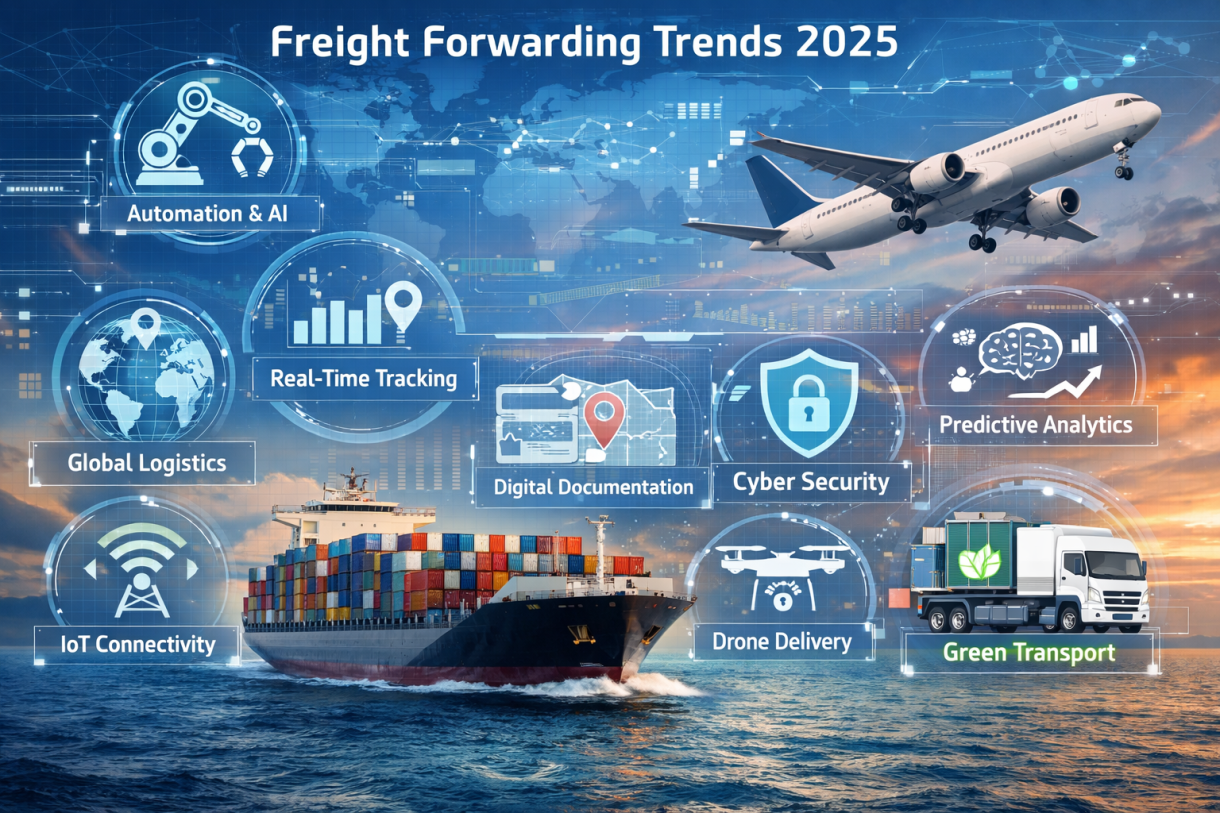
Freight Forwarding Trends to Watch in 2025: A Strategic Guide for Hawaii Logistics
In 2025, freight forwarding trends are reshaping how goods move across borders, oceans, and islands. As global trade continues to recover from years of disruption, the freight forwarding industry is undergoing rapid transformation driven by technology, sustainability demands, cost pressures, and shifting customer expectations. For Hawaii, a state deeply dependent on imports and complex multimodal logistics, staying ahead of these trends is not optional. It is a competitive necessity.
The freight forwarding market is becoming more data-driven, more regulated, and more customer-centric. Businesses that understand where the freight forwarding industry is heading will be better positioned to control costs, maintain service reliability, and adapt to uncertainty. In contrast, companies that rely on outdated practices risk delays, higher expenses, and reduced supply chain resilience.
In this article, we explore the most important freight forwarding trends shaping 2025, with specific insight into how they affect Hawaii’s unique logistics environment. From digital transformation and sustainability to market consolidation and growth outlooks, this guide provides practical, forward-looking intelligence for shippers, logistics managers, and supply chain leaders.
The Freight Forwarding Industry in 2025: Market Overview
To understand current freight forwarding trends, it helps to step back and define the landscape. What is the freight forwarding industry? At its core, it is the sector responsible for coordinating the movement of goods across international and domestic supply chains using ocean, air, rail, and truck transport. Freight forwarders act as planners, coordinators, and problem-solvers rather than asset-heavy carriers.
In 2025, the global freight forwarding market continues to grow steadily as international trade volumes rebound and supply chains diversify. The freight forwarding industry outlook 2025 reflects moderate but consistent growth, driven by e-commerce expansion, nearshoring strategies, and increased demand for supply chain visibility.
Key characteristics of the market in 2025 include:
- Continued expansion of the sea freight forwarding market
- Increased demand for specialized services and compliance expertise
- Technology investment as a baseline expectation rather than a differentiator
- Ongoing consolidation among the largest freight forwarding companies
For Hawaii, these market dynamics are magnified. Ocean freight remains dominant, air freight supports time-sensitive goods, and inland logistics require precision due to limited infrastructure flexibility.
Digital Transformation as a Core Freight Forwarding Trend
One of the most defining freight forwarding trends in 2025 is full-scale digital transformation. Forwarders are no longer experimenting with technology. They are embedding it into every operational layer.
Real-Time Visibility and Tracking
End-to-end visibility is now a baseline expectation. Shippers want to know where cargo is, when it will arrive, and what risks may arise along the way.
Benefits of real-time visibility include:
- Improved customer transparency
- Faster response to disruptions
- Better coordination between ocean, air, and ground transport
For Hawaii’s island-based supply chains, visibility is especially critical. Coordinating vessel arrivals with services like daily container drayage helps reduce port dwell time and avoid congestion-related delays.
Automation of Freight Operations
Automation is accelerating across booking, documentation, billing, and compliance. Manual processes that once slowed freight forwarding operations are increasingly replaced by integrated platforms.
Automation supports:
- Faster quote generation
- Digital document handling
- Reduced administrative errors
- Improved scalability during peak demand
As freight volumes fluctuate, automated systems allow forwarders to maintain service levels without increasing overhead.
AI and Predictive Analytics
Artificial intelligence and predictive analytics are becoming central to freight forwarding growth strategies. These tools analyze historical and real-time data to forecast demand, optimize routing, and anticipate capacity constraints.
In practice, AI helps forwarders:
- Predict seasonal surges in ocean freight
- Optimize container utilization
- Anticipate port congestion or weather-related delays
For Hawaii, where port access and vessel schedules are critical, predictive insights offer a measurable competitive advantage.
Sustainability and Green Logistics as a Market Driver
Sustainability is no longer a niche concern. It is one of the most influential freight forwarding trends shaping decision-making in 2025.
Carbon Tracking and Emissions Reduction
Many forwarders now provide carbon reporting as part of standard service offerings. Shippers increasingly expect transparency into the environmental impact of their freight movements.
Key sustainability initiatives include:
- Route optimization to reduce fuel consumption
- Carrier selection based on emissions performance
- Load consolidation to reduce total shipments
Because Hawaii relies on long-haul ocean and air routes, even small efficiency gains can produce meaningful environmental and cost benefits.
Packaging, Consolidation, and Waste Reduction
Sustainable freight forwarding extends beyond transportation. Packaging choices and shipment consolidation play a major role.
Benefits of consolidation include:
- Lower freight costs per unit
- Reduced container space waste
- Fewer overall shipments
Services such as break bulk distribution and consolidated storage strategies help Hawaiian businesses align sustainability goals with operational efficiency.
Market Consolidation and the Role of Large Forwarders
Another major freight forwarding trend is consolidation. The largest freight forwarding companies continue to expand through acquisitions, increasing their global reach and negotiating power with carriers.
At the same time, many shippers still prefer working with agile, regionally experienced partners. In Hawaii, local knowledge remains a critical differentiator despite global consolidation.
The top freight forwarders in 2025 typically offer:
- Advanced digital platforms
- Global carrier networks
- Strong compliance and customs expertise
- Scalable service models
However, regional logistics providers often deliver superior outcomes for last-mile coordination, specialized deliveries, and storage solutions.
Regulatory and Compliance Trends Impacting Forwarders
Regulatory complexity continues to increase across global supply chains. Compliance-related freight forwarding trends in 2025 include greater digitization and tighter enforcement.
Key developments include:
- Expanded digital customs filing requirements
- Increased scrutiny of documentation accuracy
- Heightened enforcement of environmental and safety standards
Forwarders that invest in compliance systems reduce the risk of delays, penalties, and shipment holds, which is especially important for high-volume importers in Hawaii.
Freight Forwarding Growth and Cost Optimization Strategies
Despite uncertainty, freight forwarding growth remains steady. Companies are focusing on cost optimization rather than pure volume expansion.
Cost-focused freight forwarding trends include:
- Strategic mode selection between ocean and air
- Better inventory planning to reduce expedited shipments
- Integration of storage into freight strategies
Storage flexibility is increasingly valuable, with solutions such as:
- Short-term storage for overflow or delays
- Long-term storage for inventory buffering
By combining transportation and storage planning, businesses improve resilience and cost predictability.
The Role of Specialized Delivery Services in 2025
Last-mile and specialized delivery services are gaining importance as freight forwarding becomes more integrated.
Common service requirements include:
- Forklift delivery for heavy freight
- Lift gate delivery for dockless locations
- Inside pick delivery for offices and retail spaces
- Retail deliveries for stores and distribution centers
- Military base and residential delivery requiring access coordination
Oversized cargo often relies on:
These services are increasingly integrated into freight forwarding contracts rather than handled as afterthoughts.
Practical Applications of Freight Forwarding Trends in Hawaii
Hawaii businesses apply these trends in real ways:
- Importers use real-time tracking to coordinate ocean arrivals with local delivery
- Retailers consolidate shipments to control freight costs and emissions
- Construction firms rely on specialized flatbed services for oversized materials
- Logistics managers leverage predictive analytics to plan around seasonal demand
Each application shows how freight forwarding trends translate into measurable operational improvements.
Best Practices for Leveraging Freight Forwarding Trends in 2025
To stay competitive, businesses should:
- Invest in digital integration and data visibility
- Prioritize sustainability metrics alongside cost
- Monitor regulatory changes continuously
- Work with partners who understand Hawaii’s logistics constraints
- Reassess freight strategies regularly as market conditions shift
Understanding how forwarders operate is also helpful. Reviewing why freight forwarders are an essential link in shipping and logistics in Hawaii provides additional context for strategic decision-making.
Conclusion: Navigating the Future of Freight Forwarding in Hawaii
Freight forwarding trends in 2025 reflect an industry that is more connected, more sustainable, and more strategically complex than ever before. For Hawaii’s import-driven economy, these trends offer both challenges and opportunities.
By embracing technology, focusing on sustainability, understanding market consolidation, and optimizing cost structures, businesses can turn freight forwarding trends into competitive advantages. The companies that succeed will be those that treat freight forwarding not as a commodity, but as a strategic pillar of their supply chain.
Frequently Asked Questions About Freight Forwarding Trends
What are the most important freight forwarding trends in 2025?
Digital transformation, sustainability initiatives, market consolidation, predictive analytics, and regulatory digitization are the most influential trends.
How does the global freight forwarding market affect Hawaii?
Global capacity, carrier pricing, and trade policies directly influence shipping costs and reliability for Hawaii-based businesses.
Is the sea freight forwarding market still growing?
Yes. Ocean freight remains the backbone of global trade and continues to grow steadily in 2025.
Why is sustainability important in freight forwarding?
Customers and regulators increasingly expect reduced emissions, transparent reporting, and responsible logistics practices.
How can businesses prepare for the freight forwarding industry outlook in 2025?
By investing in visibility tools, working with knowledgeable partners, and adapting strategies as market conditions evolve.