Military Logistics Oahu: The Definitive Guide to High-Security Military Base Delivery
Navigating military logistics on Oahu requires strict adherence to federal security protocols to ensure your cargo actually makes it past the gate without costly delays or rejections. For contractors, military families, and government vendors, a single missing credential or an unvetted driver can result in turned-away shipments, missed project deadlines, and cascading storage fees.
Because Oahu is home to several high-security installations—each with its own specific entry requirements—logistics in this region is less about simple transportation and more about precision-timed coordination and authorized access.
In this guide, you will learn how to navigate the complexities of base access, choose the right equipment for secure installations, and understand the documentation needed for a seamless drop-off. By the end, you will be able to plan your next high-security shipment with total confidence and zero downtime.
Here is what you need to know to ensure your freight arrives safely behind the wire.
Understanding High-Security Logistics for Oahu’s Military Installations
Military logistics involves the specialized transport of goods, equipment, and personal belongings into federally controlled zones that require rigorous security vetting. Unlike a standard commercial delivery, shipments destined for bases like JBPHH, Schofield Barracks, or MCBH must be managed by drivers with specific credentials and vehicles that meet strict Department of Defense (DoD) standards.
This process ensures that every item—from construction materials for base housing to household goods for service members—is accounted for and safely transitioned from civilian roads to restricted military property.
For contractors and families, navigating military base and residential delivery is a high-stakes task. Failure to coordinate with an authorized carrier can result in your shipment being impounded at the gate or sent back to a warehouse, leading to expensive "re-delivery" fees and project delays.
In the context of Oahu's geography, where the Port of Honolulu is the primary entry point for the island, having a partner who can manage the seamless transition from daily container drayage to final-mile base access is essential for maintaining your timeline and budget.
By prioritizing specialized high-security logistics, you gain several practical advantages:
- Credentialed Access: Ensure your driver possesses the necessary DBIDS (Defense Biometric Identification System) or TWIC credentials for immediate entry.
- Operational Continuity: Avoid the logistical bottleneck of gate inspections by using carriers who understand specific base protocols.
- Safety and Compliance: Reduce the risk of cargo damage or regulatory fines through the use of specialized, mission-ready equipment.
A common misconception is that any local trucking company can access a military installation. In reality, without the proper insurance and vetted personnel, most standard carriers will be stopped at the perimeter, leaving your freight stranded at the gate.
Navigating the Requirements for Military Logistics on Oahu
Successfully executing a high-security delivery requires more than just a truck and a driver; it demands a comprehensive understanding of federal access protocols and specialized equipment.
To ensure your cargo moves "behind the wire" without interruption, you must align your shipping strategy with the specific security posture of the destination. Whether you are transporting oversized construction materials or temperature-sensitive retail goods, the following steps will help you master military logistics on Oahu and avoid common gate-side pitfalls.
Step 1: Verify Driver and Vehicle Credentials
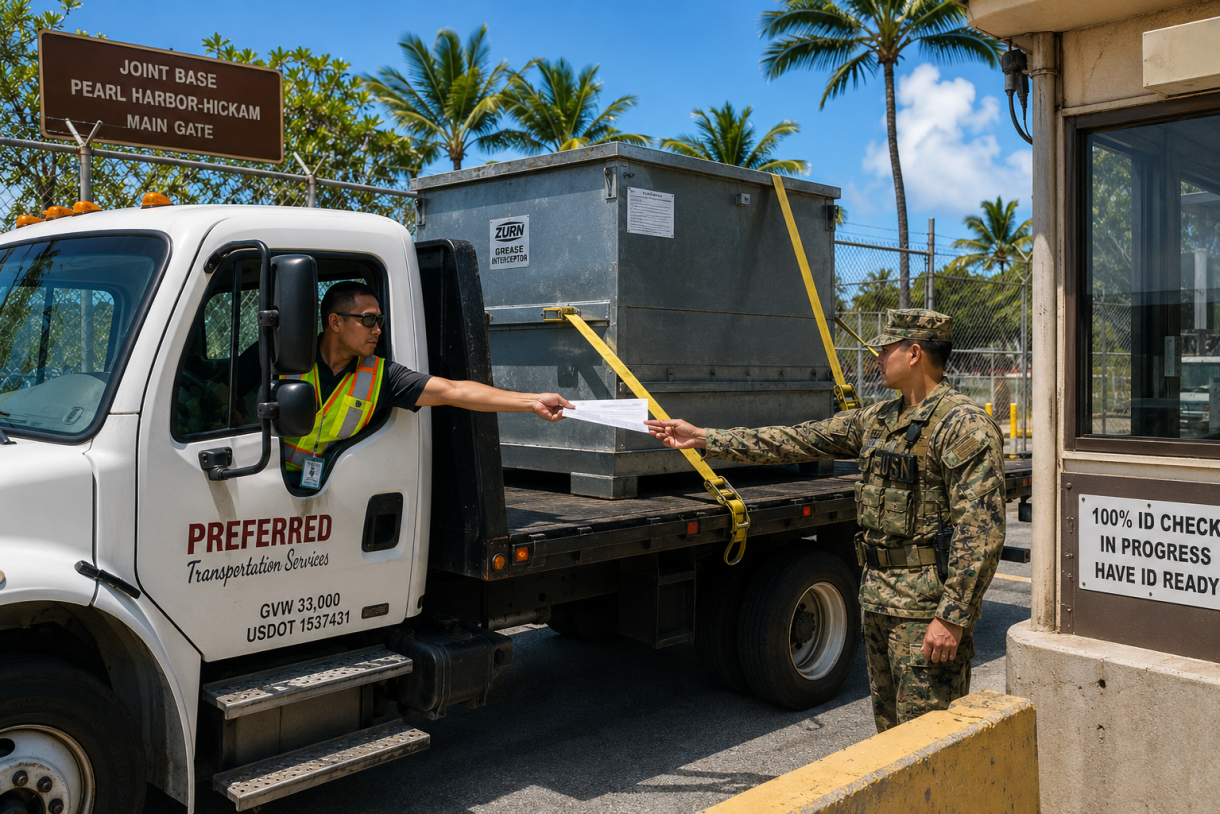
The primary hurdle for any military delivery is the security checkpoint. Drivers must possess valid, government-issued identification, but most bases also require specific credentials such as DBIDS or a TWIC card for port-connected cargo. Before the truck leaves our Kapolei hub, we verify that the driver’s background check is current and that the vehicle’s registration and insurance meet the high-liability requirements mandated by the DoD.
Step 2: Select the Right Equipment for the Mission
Military bases often have infrastructure constraints, such as tight residential corners in base housing or unimproved gravel lots at construction sites. Selecting the right vehicle is critical for a smooth offload.
- For Heavy Materials: Use flatbed trucks or drop-deck trailers for oversized items like lumber, pre-cast concrete, or machinery.
- For Palletized Goods: If the destination lacks a loading dock, ensure your carrier provides lift-gate delivery to safely lower cargo to the ground level.
- For Perishables: High-security commissaries require refrigerated box trucks (reefer units) to maintain the cold chain during the potentially long wait times at security gates.
Step 3: Coordinate the Entry and Offload Timing
Timing is everything in commercial kitchen grease trap guidelines and high-security freight alike; arriving during a "change of command" or a peak morning commute can add hours to your delivery window.
We coordinate with base sponsors or project managers to identify the best entry gates—some are dedicated solely to commercial traffic, while others are restricted to POV (privately owned vehicles). Proper coordination ensures the recipient is ready to receive the goods, preventing the driver from being turned away due to a lack of an on-site escort.
Step 4: Manage High-Security Documentation
A common point of failure in military logistics on Oahu is improper paperwork. Beyond the standard Bill of Lading (BOL), military shipments often require a "Base Access Request" or a specific "Sponsor Memo." Ensure all grease trap inspection records or industrial maintenance logs—if you are delivering specialized equipment—are clearly accessible. Having these documents ready for the gate guard significantly speeds up the inspection process.
Step 5: Final Mile Execution and Inside Delivery
Once through the gate, the "final mile" may involve more than just a curbside drop-off. For office equipment or specialty freight, you may need inside pick-up and delivery services. This means the delivery team is authorized not just to enter the base, but to enter specific buildings or offices to place the cargo exactly where it’s needed.
By following this structured approach, you eliminate the variables that typically cause high-security shipments to fail. This precision-driven process protects your cargo, your timeline, and your professional reputation with the military installations that power the island’s economy.
Military Logistics in Motion: Real-World Oahu Scenarios
Seeing how high-security transport functions in daily operations helps clarify the technical requirements for your own cargo. These use cases demonstrate how we apply specialized knowledge to solve common logistical hurdles across the island.
- The Construction Contractor: A developer needed to move oversized lumber and pre-cast concrete to a new housing project on Schofield Barracks. Using our flatbed and drop-deck trailers, we coordinated driver credentials 48 hours in advance to ensure immediate gate clearance.
The outcome was a seamless delivery that allowed the construction crew to stay on schedule without incurring "dry run" fees from a rejected truck.
- The Relocating Family: A service member’s family required a large household shipment delivered to their on-base residence at JBPHH, but the site lacked a loading dock.
We utilized a truck equipped with lift-gate delivery and provided inside-delivery support to place heavy crates exactly where needed. This action reduced the physical strain on the family and ensured the goods were secured safely within the home.
- The Government Vendor: A retail supplier needed to restock a base commissary with perishable goods. By deploying a refrigerated box truck with a pre-vetted driver, the vendor maintained the cold chain while navigating the mandatory security inspection, preventing any loss of inventory.
These examples prove that with the right preparation and equipment, navigating restricted zones becomes a routine part of a successful supply chain.
Expert Tips for Seamless Military Base Deliveries on Oahu
Applying these refined strategies is the difference between a shipment that stalls at the perimeter and one that reaches its destination without a hitch. These insights are designed to help you navigate the specific nuances of military logistics on Oahu with professional precision.
- Request the "Gate Hours" Protocol: Every installation has specific gates for commercial trucks that differ from residential or visitor gates. For example, commercial traffic for Schofield Barracks often uses the Lyman Gate, which may have restricted hours compared to the main entrance. Always confirm the current commercial gate status with your carrier to prevent a driver from being turned away after hours.
- Audit Your Cargo for Prohibited Items: High-security zones have zero-tolerance policies for specific items, including firearms or hazardous materials not listed on the manifest. Ensure your freight doesn't contain hidden "prohibited" materials that could trigger a full-vehicle search or impoundment. This is particularly vital for break-bulk distribution where multiple smaller shipments are combined.
- Maintain Real-Time Communication with the On-Base Sponsor: A delivery is only successful if there is someone to receive it. Ensure your driver has the direct phone number for the on-base POC (Point of Contact). If there is a delay at the gate inspection, the sponsor can often assist with verification to keep the truck moving.
- Double-Check Your Vehicle Insurance Limits: Military bases often require higher liability insurance limits than standard residential streets. Confirm that your transport partner carries the appropriate "Commercial Auto" and "General Liability" coverages required for federal property access to avoid a gate-side rejection.
By implementing these best practices, you reduce the risk of logistical friction and ensure your mission-critical cargo arrives on time and within budget.
Secure Your Chain of Command with Expert Oahu Logistics
Navigating the complexities of high-security delivery requires a blend of rigorous credentialing, the right equipment, and a deep understanding of local base protocols. You now understand that successful military logistics on Oahu isn't just about moving freight—it’s about coordinating access and ensuring every driver and vehicle meets the federal standards required to cross the gate.
By pre-verifying credentials and selecting mission-specific assets like flatbeds or lift-gates, you can eliminate the risk of rejected shipments and costly project delays.
Taking proactive steps now ensures your cargo moves without the friction that often plagues island-wide distribution. Whether you are supporting a construction project or a residential move, the right logistical preparation provides the peace of mind that your shipment will arrive exactly where it’s needed.
If you are ready to partner with a locally owned fleet that understands the nuances of federal access, let us help you coordinate your next military base and residential delivery.
Frequently Asked Questions About Military Logistics on Oahu
What is the difference between a grease trap and a grease interceptor for base facilities?
The primary difference between grease trap and grease interceptor systems on military bases typically involves their capacity and location. Grease traps are smaller, often located under sinks in base housing or small breakrooms, while grease interceptors are large, underground outdoor tanks designed for high-volume mess halls and commissaries.
Both require strict adherence to commercial kitchen grease trap guidelines to prevent environmental contamination on federal property, and both must be transported by credentialed carriers during facility construction or renovation.
Can any carrier handle military logistics on Oahu?
No, not all carriers can navigate the complexities of military logistics on Oahu. To access restricted areas like Schofield Barracks or Pearl Harbor, a driver must have pre-vetted credentials, such as a DBIDS or TWIC card, and the vehicle must have specific insurance levels.
Many standard delivery companies are stopped at the perimeter, which can lead to your cargo being stranded and incurring extra fees. Using an authorized fleet ensures a seamless transition from daily container drayage to on-base delivery.
How do I ensure my base delivery meets FOG wastewater treatment standards?
If you are delivering equipment for fog wastewater treatment, such as new interceptors for a military galley, you must ensure the manufacturer’s documentation is ready for inspection. High-security facilities are strictly regulated regarding fats oils and grease (FOG) management.
Providing the gate guard and the on-site sponsor with clear technical specs for your cargo helps avoid delays during the mandatory security screening process, ensuring your materials reach the job site on time.
What are FOG BMP requirements for contractors on base?
FOG BMP (Best Management Practices) for fats oils and grease are critical for contractors managing food service renovations on military property. These practices include the proper installation of grease management systems and ensuring that no debris enters the federal sewer system.
When shipping these components, your transport partner should be familiar with the "Move What Matters" philosophy, ensuring that specialized hardware is handled with the care required to meet strict government environmental standards.