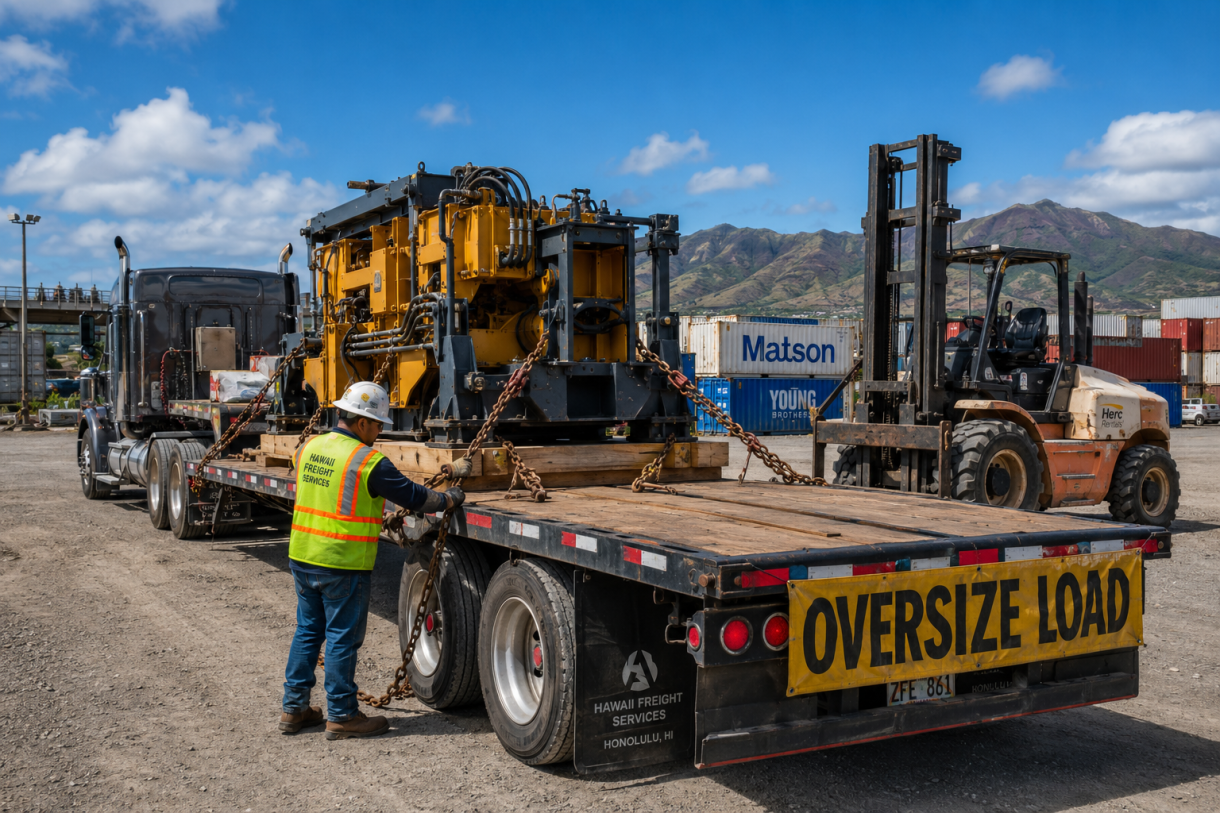
Moving the Machines: How to Choose Top-Tier Industrial Hauling and Freight Shipping Companies
When your business needs to transport oversized construction materials or high-value industrial machinery across Oahu, partnering with established freight shipping companies is the only way to avoid catastrophic logistics delays and expensive cargo damage.
The top industrial hauling and freight shipping companies distinguish themselves by owning a versatile, specialized fleet and maintaining direct port interchange agreements rather than operating as detached third-party brokers. For island businesses, selecting a provider with dedicated assets ensures your heavy machinery and project supplies move seamlessly from the port to the jobsite without getting stranded in transit.
Failing to secure a reliable, asset-heavy transporter can paralyze a commercial jobsite, driving up project overhead and straining your client relationships. This guide delivers a transparent breakdown of how top-tier estes freight shipping networks and local specialists manage complex island logistics. You will understand how to analyze carrier fleets, evaluate terminal networks, and choose the most reliable transport partner for your supply chain.
Let's look at what sets elite transport carriers apart from standard logistics brokers.
Core Logistics: Understanding the Role of Top-Tier Freight Shipping Companies
In industrial supply chains, freight shipping Companies function as the foundational backbone that keeps heavy machinery, manufacturing materials, and retail goods moving across the country and between the islands.
These specialized transportation providers utilize a structured network of terminals, tracking technology, and dedicated fleets to coordinate the overland movement of commercial cargo. From massive flatbed operations to localized box truck distribution, they transform complex port arrivals into organized, final-mile deliveries.
For commercial developers, construction firms, and business owners in Hawaii, understanding how these carriers operate is essential for protecting your raw materials and controlling your operational overhead. Working with an asset-backed carrier that handles your daily container drayage from the port directly safeguards your timeline against bottleneck delays at the harbor.
Relying on an experienced local fleet ensures you have immediate access to specialized flatbed and drop-deck trailers required to haul heavy industrial components safely over island roads. Selecting the right logistics infrastructure prevents costly project shutdowns, safeguards your materials, and ensures your community stays connected to vital resources.
Partnering with established freight shipping companies offers several practical advantages for your business:
- Asset-Based Control: True asset-based carriers utilize their own dedicated trucks and drivers, ensuring a single point of accountability for your cargo.
- Streamlined Port Access: Direct interchange agreements with major maritime lines ensure your sea containers are pulled from the terminal without costly storage penalties.
- Specialized Routing Expertise: Experienced drivers understand the weight restrictions and security protocols of specific commercial corridors and industrial zones.
A common industry mistake is assuming that national ltl freight carriers manage land transport on Oahu with the same direct fleet capacity they use on the mainland. In reality, many national brands lack local physical assets in Hawaii, meaning they must hand off your high-value cargo to localized subcontractors, which increases your overall risk of communication gaps and tracking dropouts.
Operational Mechanics: Evaluating National Networks and Local Fleet Assets
Top-tier freight shipping companies maintain operational integrity by combining extensive regional networks with specialized heavy equipment. While a national estes shipping company or a major logistics conglomerate excels at moving bulk goods over thousands of miles of mainland highway, island distribution demands local, asset-heavy precision.
To protect your commercial supply chain from expensive transit delays, business owners must understand the distinct operational layers that define elite transport logistics.
1. Unified LTL Freight Networks
Less-than-truckload logistics rely on a highly organized hub-and-spoke terminal system. Regional ltl freight carriers consolidate smaller commercial shipments from multiple businesses into a single truck, allowing companies to share transport costs.
This system requires highly efficient cross-dock terminals where cargo is sorted, staged, and reloaded within strict time windows. For businesses moving smaller pallets of building supplies or retail stock, utilizing a standardized network keeps transport costs completely manageable.
2. Digital Freight Tracking and System Integration
Modern industrial shipping demands real-time data transparency from origin to final destination. Major carrier systems like estes transport tracking or advanced cloud-based logistics platforms use cellular GPS units mounted directly on the truck chassis and automated barcode scanning at every terminal checkpoint.
This continuous data feed provides supply chain managers with automated arrival estimates, clear proof-of-delivery signatures, and instant notifications regarding potential route adjustments. Integrating a reliable tracking system into your supply chain eliminates the guesswork of material staging at your facility.
3. Specialized Flatbed and Heavy Hauling Fleet
Moving heavy industrial machinery, structural steel, or pre-cast concrete requires specialized trailing equipment designed for extreme payloads. Unlike standard enclosed vans used by a typical estes trucking company, industrial haulers deploy heavy-duty flatbeds, drop-deck trailers, and lowboys to accommodate irregular dimensions and concentrated weights.
Safely transporting these large-scale materials requires drivers trained in specialized load-securement methods, including heavy-grade chains, heavy-duty straps, and edge protectors. Utilizing an asset-backed local provider that manages its own flatbed trucks ensures your heavy machinery moves without the risk of equipment failure.
4. Advanced Terminal Cross-Docking and Break-Bulk
When bulk sea containers arrive at an island port, the cargo must be systematically broken down and prepped for local island delivery routes. Top-tier logistics providers utilize secure warehouse terminals to execute precision break-bulk distribution, separating massive commercial freight shipments into smaller, more agile delivery loads.
This intermediate staging step allows carriers to match specific cargo to the correct delivery vehicle, protecting your goods while streamlining final delivery across tight urban corridors.
5. Final-Mile Lift-Gate and Specialized Delivery
The final leg of industrial transit is often the most logistically challenging, especially when delivering to commercial facilities or construction zones that lack built-in loading docks. Asset-heavy carriers resolve this issue by deploying specialized delivery trucks equipped with heavy-duty hydraulic lifts.
Utilizing professional lift-gate delivery systems allows a single driver to safely lower heavy, palletized materials straight to the ground level without requiring a building forklift. This independent unloading capability keeps your final-mile delivery moving efficiently while reducing overall on-site labor demands.
Understanding these operational layers allows you to build a resilient supply chain that easily handles everything from transpacific container drayage to specialized final-mile delivery.
Island Logistics in Action: How Oahu Industries Apply Professional Freight Solutions
Reviewing how these operational mechanics perform in daily commercial scenarios demonstrates the real-world value of choosing asset-backed transporters. Let's look at how local companies apply specialized freight logistics to protect their project timelines and eliminate supply chain bottlenecks.
- The West Oahu Commercial Development: A large-scale construction firm building a retail complex in Kapolei faced immediate project delays when a shipment of heavy structural steel arrived at the harbor. Instead of waiting on standard mainland ltl freight carriers to coordinate a subcontractor, the developer partnered with a local flatbed transport specialist.
The asset-based carrier immediately deployed their own drop-deck trailers to haul the steel directly from the terminal, keeping the construction schedule perfectly on track and avoiding expensive on-site labor delays.
- The Honolulu Retail Distribution Setup: A major electronics retailer in downtown Honolulu needed to distribute high-value, palletized inventory across several island storefronts securely. The store manager utilized an asset-backed fleet that provided precise, real-time tracking updates alongside professional inside pick-up and delivery services.
This direct operational approach completely removed the risk of cargo damage, keeping their store shelves fully stocked and improving their overall supply chain visibility.
- The Central Oahu Cold Storage Project: A food distribution warehouse at Schofield Barracks required immediate break-bulk sorting for an incoming maritime container filled with perishable items.
By routing the shipment through a local asset-heavy terminal, they quickly separated the palletized cargo into specialized refrigerated box trucks, ensuring the temperature-sensitive cargo arrived safely with zero product spoilage.
These practical examples prove that partnering with top-tier freight shipping companies provides the asset ownership, local equipment, and tracking transparency required to handle any logistical challenge with absolute certainty.
Expert Logistics Tips: Maximizing Your Freight Shipping Efficiency
Applying these professional transportation strategies bridges the gap between simply understanding shipping routes and actively optimizing your supply chain performance. Implement these grounded, asset-focused steps to maximize the value you receive from top-tier freight shipping companies while completely eliminating unnecessary handling delays.
- Audit Equipment Availability Before Booking: Never assume national ltl freight carriers have specialized trailing assets sitting ready at a local terminal. Always verify that your chosen transporter owns the specific flatbeds, drop-deck trailers, or heavy-duty chassis required for your industrial load before finalizing your timeline. If your cargo requires a mobile forklift on-site, scheduling a dedicated forklift delivery configuration ensures your site is never left stranded without unloading equipment.
- Streamline Your Bill of Lading Documentation: Accurate documentation is the ultimate defense against unexpected accessorial fees and transit delays. Ensure your warehouse team inputs exact pallet dimensions, certified freight weights, and specific NMFC classification codes into the system prior to driver arrival.
A minor paperwork error can cause major national networks like an estes shipping company to flag your freight for re-weighing, stalling your cargo at an intermediate cross-dock terminal.
- Utilize Integrated Real-Time Tracking Tools: Avoid relying on manual phone updates to check the current status of your high-value industrial machinery. Train your logistics coordinators to actively use digital systems like estes freight tracking or carrier-specific GPS portals to monitor transit checkpoints. Having a live, automated data feed allows you to coordinate on-site rigging crews and labor schedules precisely with the truck's actual arrival window.
Consistently practicing these proactive shipping strategies ensures your cargo remains completely safe, your project sites operate efficiently, and your business stays protected against unexpected transport overhead.
Long-Term Supply Chain Security: Partnering with Top Freight Shipping Companies
Securing a reliable land transport system on Oahu requires a careful balance between national network tracking and local fleet ownership. You now understand how top-tier freight shipping companies utilize asset-based flatbeds, drop-deck trailers, and hydraulic lifts to safely execute complex port extractions and final-mile industrial deliveries.
Recognizing how major networks like an estes trucking company function alongside dedicated local logistics operators allows you to optimize your delivery schedules, eliminate costly port storage penalties, and manage your overhead with complete confidence.
Taking immediate control of your regional supply chain protects your business from costly project delays and the operational chaos of stranded cargo. Securing a dedicated transportation partner with verified interchange agreements means your commercial inventory and heavy machinery will always receive the highest level of ground support on the island.
If you are ready to streamline your port-to-door distribution and safeguard your oversized cargo, contact Preferred Transportation Services today to book your next reliable daily container drayage.
Frequently Asked Questions About Industrial Hauling and Freight Shipping Companies
Why should I choose an asset-based provider over standard freight shipping companies that operate as brokers?
Asset-based providers own their trucks, flatbeds, and terminals, ensuring direct accountability, predictable pricing, and reliable driver scheduling. Traditional brokers do not own equipment and must constantly subcontract your cargo out to third-party fleets.
For complex island logistics, working with an asset-heavy team prevents tracking communication drops and guarantees that specialized trailers are physically available when your sea containers arrive at the port.
How do local logistics providers interface with national networks like an estes shipping company?
Local logistics specialists act as the essential "boots on the ground" final link for national carriers that lack physical terminals or specialized delivery assets in Hawaii. When bulk commercial freight arrives from a national estes trucking company network at the Honolulu harbor, a local partner handles the rapid port drayage, container stripping, and final-mile transport to ensure your cargo arrives safely at its destination.
Can regional ltl freight carriers handle oversized industrial machinery on Oahu?
Standard ltl freight carriers are primarily built to consolidate enclosed, palletized box truck shipments and usually cannot handle oversized industrial machinery. Moving irregular or heavy industrial loads requires a carrier with an asset-backed local fleet of specialized flatbed trucks and drop-deck trailers. These units provide the structural strength, open access, and heavy-duty load securement tools required to haul heavy payloads safely across island corridors.
What is the most effective way to monitor my cargo using estes freight tracking systems?
The best approach is to integrate the tracking numbers directly into your warehouse management software or use the carrier's automated digital notification portal. Systems like estes transport tracking utilize live cellular GPS sensors on their equipment to update transit statuses at every major milestone. This immediate visibility allows your project managers to coordinate staging labor and heavy rigging crews precisely with the truck’s actual arrival.