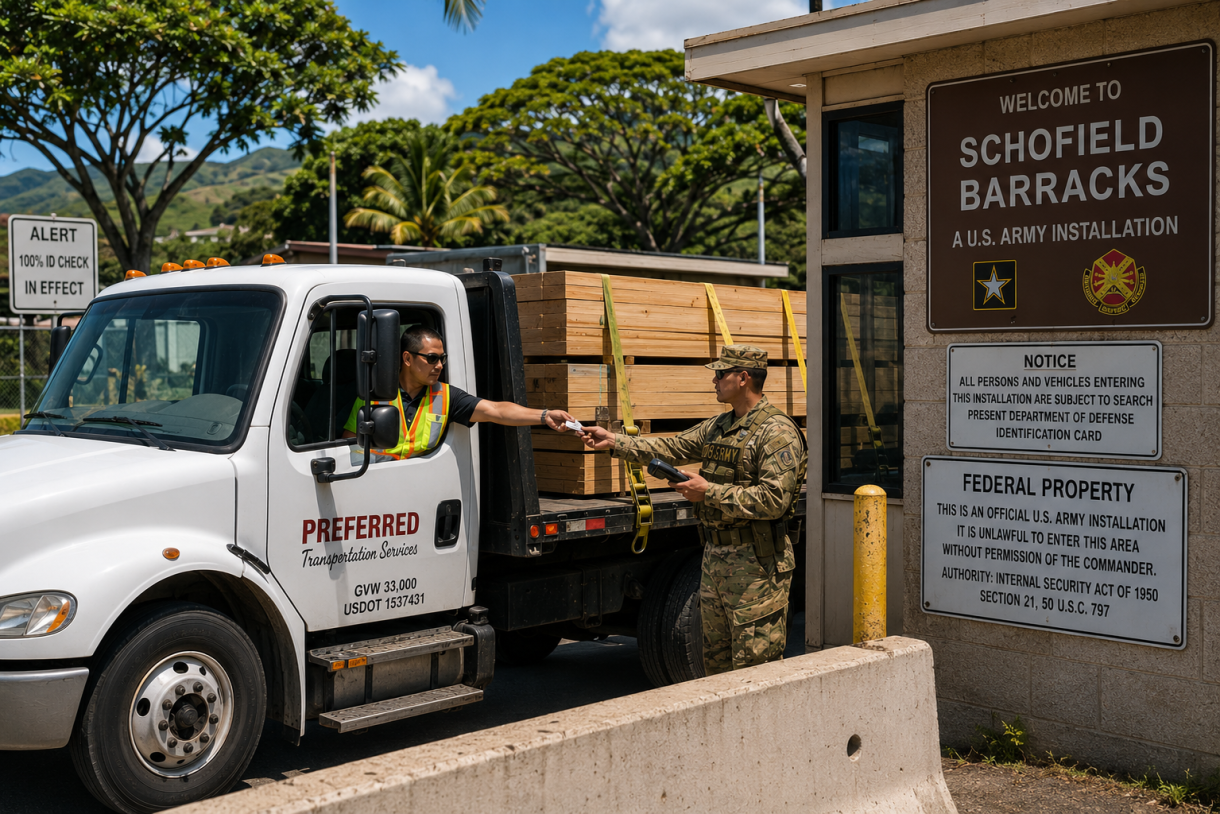
Security Credentials and Proven Reliability: Our Track Record in High-Security Zones
Navigating the stringent requirements for security credentials on Oahu is the difference between a successful project and a cargo shipment stalled at a military checkpoint. For government contractors and commercial developers, the fear of gate-side rejections or "blacklisted" drivers is a constant operational risk that can lead to missed deadlines and federal contract penalties.
Without the proper high-security credentials, even a simple delivery of construction materials to Schofield Barracks or JBPHH can become an expensive logistical nightmare.
In this article, you will understand the essential protocols for maintaining high-security zone compliance and how to verify that your transportation partner possesses the necessary verified security credentials. We will break down the complexities of DBIDS and TWIC requirements, helping you make informed decisions that protect your project's timeline and reputation.
By mastering these standards, you ensure your mission-critical freight moves through the island’s most restricted zones with professional precision. Here is how we maintain the highest level of contractor credential security on every haul.
Why Security Credentials are Critical for Oahu Logistics
In the context of Hawaii's transportation landscape, security credentials are the formal authorizations and background-verified identifications required for personnel and vehicles to enter restricted federal and commercial sites. This system functions through specialized programs like the Defense Biometric Identification System (DBIDS) for military bases and the Transportation Worker Identification Credential (TWIC) for maritime ports.
These are not merely suggestions; they are mandatory requirements that verify a driver has undergone rigorous federal screening to ensure high-security zone compliance before they can cross a perimeter.
For government contractors and commercial developers, this matters because your supply chain is only as strong as its final-mile access. If your logistics provider lacks military base and residential delivery authorization, your cargo—whether it is pre-cast concrete for a barracks renovation or retail inventory for a base exchange—will be turned away at the gate.
This causes immediate financial loss through "dry run" fees and delayed project milestones. By ensuring your partner has verified security credentials, you mitigate the risk of operational downtime and protect your standing with federal agencies.
Prioritizing a partner with proper facility security credentials offers several measurable advantages:
- Zero-Gate Friction: Avoid the hours of delay associated with temporary pass applications or secondary vehicle inspections.
- Contractual Integrity: Fulfill the "on-time" delivery clauses of your government contracts by utilizing a fleet pre-cleared for inside pick-up and delivery services.
- Reduced Liability: Minimize the safety risks associated with unvetted personnel entering sensitive job sites or military housing areas.
A common mistake is assuming a standard commercial driver's license is sufficient for all Oahu deliveries. In reality, without specialized government contractor security credentials, the port and the base remain inaccessible, regardless of the urgency of the shipment.
Maintaining Operational Excellence Through Verified Security Credentials
Securing a logistics partner with the correct security credentials is the only way to guarantee that your freight reaches its destination on Oahu without being halted at a perimeter.
This requires more than just a background check; it involves active participation in federal programs that grant secure access credentials to specific ports and military installations. By understanding how these credentials function, you can better audit your carriers and ensure they meet the high standards of contractor credential security required for your specific mission.
The Role of DBIDS in Military Installation Access
The Defense Biometric Identification System (DBIDS) is the primary tool used by the Department of Defense to manage access to military bases like Pearl Harbor-Hickam and Marine Corps Base Hawaii.
For a driver to move cargo onto these sites, they must be enrolled in DBIDS with a valid sponsor. We ensure our drivers maintain these high-security credentials year-round so that when your container arrives via daily container drayage, there is no delay in pulling it from the port and delivering it directly "behind the wire."
Navigating Port Security with TWIC
While DBIDS governs the base, the Transportation Worker Identification Credential (TWIC) is the standard for unescorted access to secure areas of the Port of Honolulu. This biometric credential, issued by the TSA, is a mandatory requirement for any worker entering maritime facilities.
By maintaining a fleet of TWIC-cleared drivers, we provide seamless break-bulk distribution directly from the pier. This level of credential security prevents the common bottleneck where a driver must wait for a port-issued escort, which can add hours—and significant costs—to a single delivery.
Vehicle Compliance and Insurance Standards
An often-overlooked component of security credentials is the status of the vehicle itself. To enter a high-security zone, a vehicle must be in peak operational condition and carry insurance limits that far exceed standard commercial policies.
- Proof of Registration: Vehicles must have current Hawaii registration and safety checks visible at all times.
- Liability Coverage: Federal installations often require $1,000,000 or more in liability coverage to protect government property during offloading.
- Right-Sized Equipment: For oversized construction loads, we utilize flatbed and drop-deck trailers that are pre-vetted for base entry, ensuring the equipment is as compliant as the driver.
Adhering to the "Sponsor Memo" and Delivery Orders
Even with the best verified security credentials, a delivery can fail if the paperwork does not match the mission. Every high-security delivery requires a valid Delivery Order or a "Sponsor Memo" that identifies exactly who is receiving the goods and where they are going. We coordinate directly with your on-base point of contact to ensure that our drivers have the exact documentation needed for the gate guard.
This meticulous approach to high-security zone compliance eliminates the confusion that often leads to drivers being turned away during shift changes or heightened security postures.
By strictly adhering to these protocols, you transform your logistics from a variable risk into a predictable asset. Whether you are moving sensitive electronics or heavy building materials, our commitment to security clearance credentials ensures that your "move what matters" philosophy is upheld from the first mile to the final destination.
Verified Security Credentials in Action: Oahu Success Stories
Seeing how security credentials function in high-pressure environments clarifies the technical requirements for your own logistics strategy. These real-world scenarios demonstrate how high-security zone compliance prevents costly delays for diverse Oahu projects.
- The Military Housing Developer: A construction firm was tasked with a rapid renovation of base housing at JBPHH. Because the project required hundreds of pallets of flooring, they utilized our lift-gate delivery services, which were managed exclusively by drivers with pre-verified DBIDS credentials.
This action allowed for daily, unescorted entry to the residential zone, resulting in zero gate-side wait times and a project completion that was three days ahead of schedule.
- The Critical Infrastructure Vendor: A government contractor needed to deliver heavy electrical switchgear to a restricted area within the Port of Honolulu. By deploying a driver with active security clearance credentials and a TWIC card, we facilitated an immediate pickup from the pier.
The outcome was a direct, secure transit that bypassed the need for a third-party port escort, saving the client nearly $500 in service fees and avoiding four hours of terminal downtime.
- The On-Base Office Move: For a sensitive administrative relocation, we provided inside pick-up and delivery using personnel with the highest level of facility security credentials. This ensured that mission-critical office equipment was handled by vetted professionals who were authorized to enter secure federal office spaces.
These examples prove that the right credentials aren't just about identification; they are the key to maintaining a fluid and reliable supply chain. By choosing a partner with verified security credentials, you can expect the same level of professional precision for your next mission.
Expert Insights for Navigating Security Protocols on Oahu
Applying these experience-based insights is the difference between a fluid logistics operation and a shipment stalled at a high-security gate. These tips focus on the nuances of high-security zone compliance, ensuring your cargo moves without the friction of administrative errors or credential lapses.
- Utilize Pre-Vetting Portals for Faster Entry: As of 2026, many military installations, including U.S. Army Garrison Hawaii, have transitioned to online visitor vetting systems.
By submitting your driver's information and secure access credentials through these select portals 48 to 72 hours in advance, you can significantly reduce wait times at Visitor Control Centers (VCC). This digital pre-clearance is essential for maintaining tight delivery windows at Schofield Barracks and Wheeler Army Airfield.
- Verify REAL ID Act Compliance on All State IDs: For drivers without a current CAC or TWIC, a state-issued driver's license must be REAL ID compliant to serve as a valid form of identification at federal gates.
Before scheduling a pickup, we audit our team’s security clearance credentials to ensure every license is current and carries the required gold star. A single non-compliant ID can lead to a vehicle being turned away, triggering a costly "dry run" fee for your project.
- Keep Vehicle Documents Staged and Ready: Security personnel at high-security zones will always verify a vehicle’s registration, safety inspection, and proof of no-fault insurance.
We stage these documents in a dedicated "compliance folder" within every cab, including specialized permits for flatbed trucks carrying oversized loads. This organization speeds up the perimeter inspection process and demonstrates a high level of contractor credential security.
- Coordinate "Sponsor-Sided" Verification: Even with a valid pass, gate guards may require a verbal or digital confirmation from the on-base sponsor. We recommend confirming with your site contact that they are "active" in the system on the day of delivery.
This extra layer of verified security credentials management prevents drivers from being stuck at the gate during shift changes or heightened security postures (FPCON changes).
By integrating these professional best practices into your planning, you ensure that high-security zone compliance becomes a seamless part of your supply chain rather than a hurdle to overcome.
Secure Your Supply Chain with Verified Security Credentials
Navigating Oahu’s restricted zones requires more than just a truck; it demands a partner with the correct security credentials and a deep understanding of federal access protocols. You now have the insights needed to verify high-security zone compliance and ensure your logistics provider can handle the complexities of DBIDS, TWIC, and real-time gate coordination. By prioritizing verified security credentials, you eliminate the risks of gate-side rejections and costly project delays.
Choosing a pre-cleared transportation partner today protects your project's reputation and ensures your mission-critical materials are never left stranded at a checkpoint. With the right credentials in place, you can focus on your project’s success while we handle the complexities of high-security access. To ensure your cargo moves seamlessly through the island's most restricted areas, explore our specialized solutions for military base and residential delivery.
Common Questions Regarding Security Credentials on Oahu
What are the main security credentials required for military base deliveries on Oahu?
As of 2026, the primary security credentials required for base access are the Defense Biometric Identification System (DBIDS) card and a REAL ID-compliant driver’s license. For maritime facilities like the Port of Honolulu, a Transportation Worker Identification Credential (TWIC) is also mandatory.
We maintain a fleet of drivers who carry these verified security credentials year-round, ensuring that your daily container drayage or equipment delivery never faces a perimeter rejection.
Can a delivery driver access a high-security zone without a TWIC or DBIDS?
It is extremely difficult and often impossible for an unvetted driver to gain entry without these secure access credentials. While some gates offer temporary visitor passes, the process requires a formal sponsor and an immediate background check, which can take several hours and is never guaranteed.
Utilizing a partner with pre-cleared high-security credentials is the only way to avoid these unpredictable delays and ensure your project stays on its federal timeline.
How does REAL ID compliance affect contractor credential security?
Since May 2025, federal law requires a REAL ID-compliant license (marked with a star) for all individuals attempting to enter federal facilities or military bases. Standard Hawaii licenses that are not REAL ID compliant are no longer accepted for high-security zone compliance at checkpoints.
We strictly audit our team to ensure every driver’s credential security meets these updated federal standards, preventing "dry run" fees and ensuring mission-critical freight is delivered without a hitch.
Is specialized equipment required for deliveries to high-security zones?
In many cases, yes. High-security sites often have strict regulations regarding vehicle maintenance, weight limits, and cargo securement. For example, delivering oversized materials to a secure construction site requires flatbed and drop-deck trailers that are pre-vetted for base entry.
Our equipment is not only right-sized for the job but also carries the high-limit insurance and current safety inspections required to pass through a military or federal checkpoint safely.