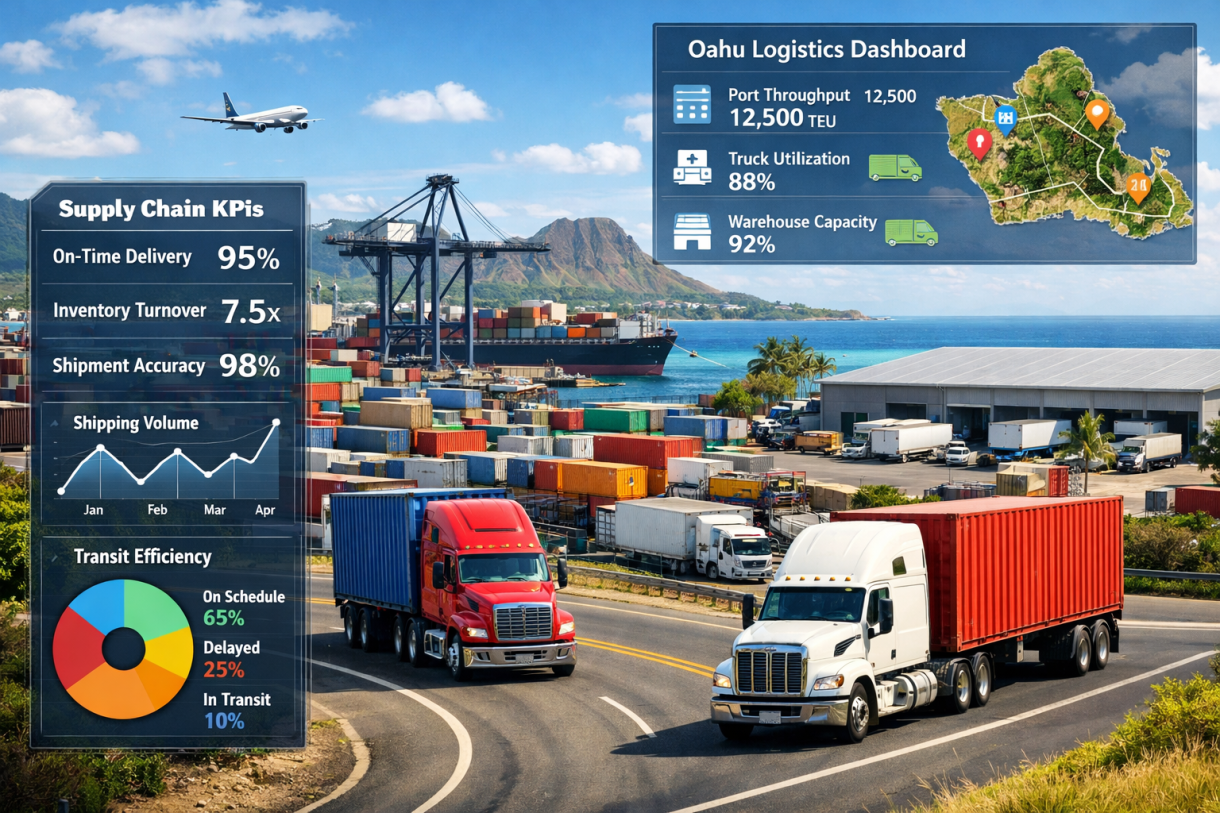
Supply Chain KPIs: Key Metrics to Track Logistics Performance
Why Measuring Supply Chain Performance Matters in Hawaii
Managing logistics in Hawaii presents unique challenges compared to mainland supply chains. Ocean freight dependencies, port scheduling, limited road networks, and island distribution all require careful coordination.
Because of these factors, tracking supply chain KPIs is essential for maintaining operational efficiency and reliability.
Key performance indicators help logistics managers monitor performance across every stage of the supply chain, from container arrival at port to final delivery.
For businesses operating across Oahu and the Hawaiian Islands, tracking supply chain performance metrics helps:
- Identify operational bottlenecks
- Improve delivery reliability
- Reduce transportation and storage costs
- Strengthen supplier and carrier relationships
- Improve customer satisfaction
When logistics operations rely on coordinated services such as daily container drayage, warehousing, and final-mile distribution, consistent KPI tracking becomes essential.
What Are Supply Chain KPIs?
Supply chain KPIs (Key Performance Indicators) are measurable values used to evaluate the efficiency, reliability, and cost-effectiveness of supply chain operations.
These supply chain key performance indicators provide visibility into every stage of logistics operations, including transportation, warehousing, inventory management, and supplier performance.
Common categories of supply chain management KPIs include:
- Transportation efficiency
- Inventory performance
- Order fulfillment accuracy
- Supplier reliability
- Delivery performance
For companies managing freight transportation and distribution across Hawaii, tracking logistics key performance indicators ensures each stage of the supply chain operates efficiently.
Core Supply Chain KPIs Every Business Should Track
On-Time Delivery Rate
The on-time delivery rate measures how often shipments arrive within the promised delivery window.
Formula:
(On-Time Deliveries ÷ Total Deliveries) × 100
In Hawaii, where shipments depend heavily on ocean freight and port coordination, maintaining a high on-time delivery rate is critical.
Reliable transportation services such as retail deliveries and military base and residential delivery help businesses maintain consistent delivery performance.
Freight Cost per Shipment
Transportation costs represent a major portion of logistics expenses.
Tracking freight cost per shipment or per mile helps businesses:
- Identify inefficient delivery routes
- Compare carrier performance
- Optimize shipment consolidation
Specialized services like flatbed trucks and flatbed drop deck trailers may be used depending on cargo type, and cost monitoring helps ensure these resources are used efficiently.
Inventory Turnover Rate
Inventory turnover measures how quickly goods move through the warehouse.
Formula:
Cost of Goods Sold ÷ Average Inventory
A high turnover rate indicates efficient inventory management and strong demand forecasting.
Warehousing solutions such as short-term storage and long-term storage can impact this metric significantly.
In Hawaii, where storage space can be limited, improving turnover reduces warehouse costs and minimizes obsolete inventory.
Order Accuracy Rate
Order accuracy measures the percentage of shipments delivered without errors.
Errors in picking, labeling, or documentation can create delays, returns, and dissatisfied customers.
High accuracy levels are especially important for businesses relying on services such as:
Accurate order fulfillment ensures products reach customers correctly and on schedule.
Port-to-Warehouse Transit Time
Because Hawaii relies heavily on ocean freight, tracking the time between container arrival and warehouse intake is a critical KPI.
This metric helps logistics teams:
- Monitor container drayage efficiency
- Reduce demurrage fees at ports
- Improve scheduling coordination
Efficient drayage and warehouse intake help maintain consistent supply chain flow.
Last-Mile Delivery Performance
Last-mile delivery represents one of the most time-sensitive stages of the supply chain.
Key metrics to monitor include:
- Average delivery time
- Failed delivery attempts
- Customer confirmation rates
Vehicles such as dry and refrigerated box trucks help maintain temperature-sensitive deliveries while ensuring consistent delivery performance.
Optimizing last-mile logistics can significantly improve customer satisfaction.
Supplier KPIs and Vendor Performance
In addition to transportation metrics, supplier KPIs play a critical role in supply chain management.
Supplier performance indicators may include:
- Supplier lead time
- Order fulfillment accuracy
- Supplier defect rate
- On-time supplier deliveries
Strong supplier performance ensures that goods move efficiently through the entire supply chain.
These key performance indicators in supply chain management help businesses maintain strong vendor relationships and reliable inventory flow.
Inventory Optimization Metrics That Matter Most
Effective inventory management requires monitoring several key metrics.
Important inventory optimization metrics that matter most include:
- Inventory turnover rate
- Stockout frequency
- Order fulfillment rate
- Days of inventory on hand
Tracking these metrics helps businesses maintain optimal inventory levels while avoiding excess storage costs.
In island markets like Hawaii, efficient inventory management is especially important because restocking often depends on ocean freight schedules.
Real-World Examples of Supply Chain KPIs in Action
Retail Distribution Across Oahu
A retail distributor tracks on-time delivery rates and freight cost per mile.
By optimizing delivery routes and consolidating shipments, the company reduces fuel costs and improves delivery reliability.
Construction Supply Logistics
A construction supplier monitors port-to-warehouse transit time and order accuracy.
Improved container scheduling and warehouse coordination reduce job site delays and keep projects on schedule.
Break Bulk Distribution Efficiency
Companies handling break bulk distribution track unloading efficiency and cargo handling times.
These metrics help reduce port congestion and speed up delivery timelines.
Best Practices for Tracking Supply Chain KPIs
To maximize the value of supply chain KPIs and metrics, businesses should follow several best practices.
Use reliable data tracking systems
Technology platforms help track shipments, inventory, and delivery performance accurately.
Review KPIs regularly
Monthly and quarterly reviews allow managers to identify trends and address issues early.
Align KPIs with business goals
Metrics should focus on cost control, delivery performance, and customer satisfaction.
Collaborate with logistics partners
Sharing KPI data improves coordination between transportation providers and warehouses.
Adapt to Hawaii-specific logistics challenges
Weather conditions, port schedules, and island infrastructure all influence logistics performance.
The Role of Reverse Logistics in Supply Chain Performance
Returns and product recovery also play an important role in supply chain efficiency.
Businesses focused on sustainability and operational improvement often track reverse logistics metrics as part of their overall KPI strategy.
For example, reverse logistics can contribute to environmental improvements and cost savings, as discussed in this article on reverse logistics and sustainability.
Final Thoughts on Supply Chain KPIs
Tracking the right supply chain KPIs provides businesses with the visibility needed to manage logistics effectively.
From transportation efficiency and inventory management to supplier performance and last-mile delivery, these supply chain performance metrics allow companies to make informed decisions and improve operational outcomes.
In Hawaii’s unique logistics environment, where ocean freight, limited infrastructure, and tight delivery windows are common, data-driven supply chain management is essential.
By consistently monitoring the right metrics, businesses can reduce costs, improve reliability, and strengthen long-term supply chain performance.
Frequently Asked Questions About Supply Chain KPIs
What are supply chain KPIs?
Supply chain KPIs are measurable indicators used to evaluate logistics performance, including transportation efficiency, inventory management, and delivery reliability.
Why are supply chain KPIs important?
They help businesses identify inefficiencies, reduce costs, and improve overall supply chain performance.
What are examples of supply chain KPIs?
Examples include on-time delivery rate, freight cost per shipment, inventory turnover, order accuracy, and supplier performance metrics.
How often should supply chain KPIs be reviewed?
Most companies review KPIs monthly, with deeper quarterly evaluations to identify trends and operational improvements.
Can small businesses use supply chain KPIs?
Yes. Even smaller companies benefit from tracking basic logistics metrics to improve efficiency and customer satisfaction.