What Types of Loads Can Be Transported Through Heavy Equipment Hauling Services?
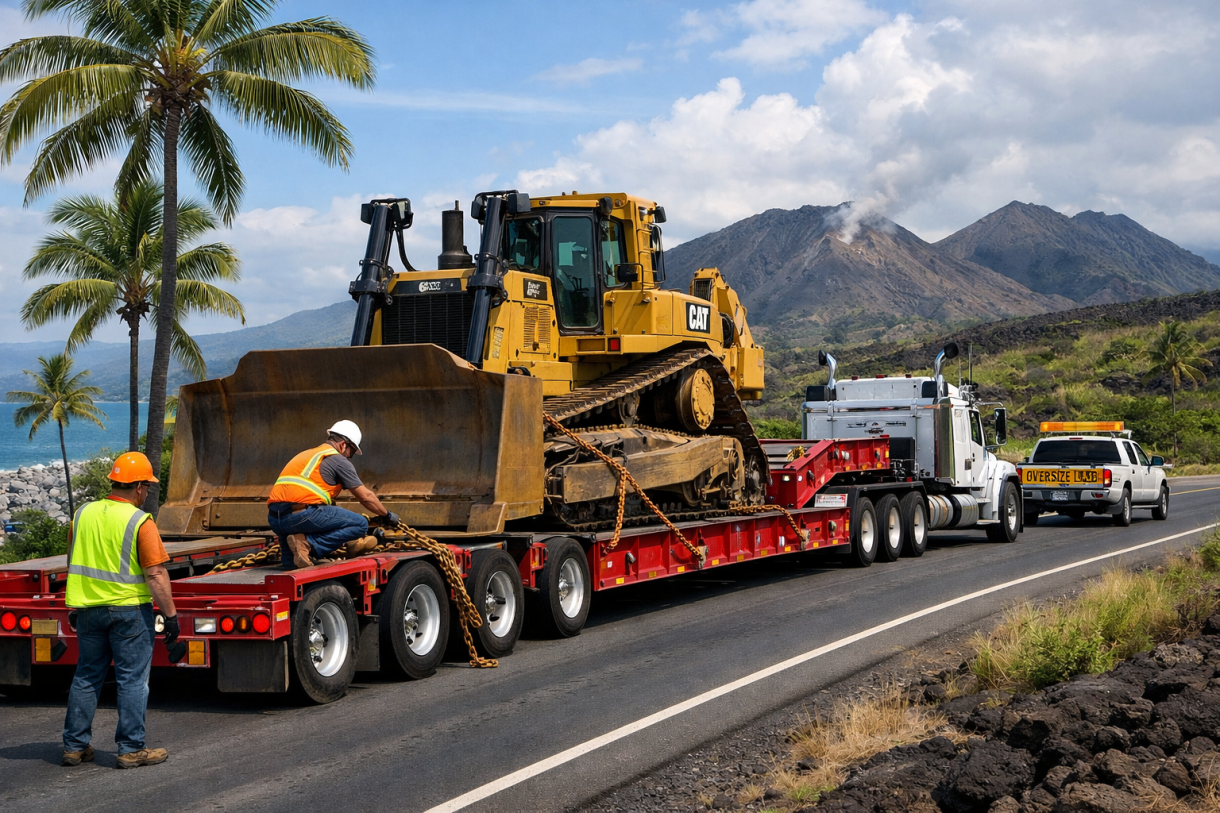
Professional heavy equipment hauling services are designed to move a vast array of massive, high-value assets that exceed the capacity of standard freight vehicles. Primary loads include construction equipment hauling for excavators and loaders, bulldozer transport, and specialized industrial equipment transport for manufacturing machinery.
Furthermore, these services accommodate oversized load transport, such as generators, transformers, and large-scale infrastructure components. To ensure safety and regulatory compliance, top-tier heavy equipment hauling services utilize specialized trailers like drop decks and lowboys, providing the necessary stability and height clearance for the most challenging inter-island or local industrial moves.
A Closer Look at Heavy Equipment Hauling
Transporting massive machinery across Hawaii’s varied terrain requires more than just a large truck; it demands a strategic logistics plan. Professional heavy equipment hauling is a specialized field where the choice of trailer and the expertise of the crew directly impact the safety and legality of the move.
What Actually Works for Heavy Equipment Hauling Services (and Why)
The key to successful heavy equipment hauling services lies in matching the specific load to the correct trailer configuration. For example:
- Lowboys and RGNs: These are essential for bulldozer transport and large excavators. Their low deck height allows tall machinery to clear overpasses, while Removable Gooseneck (RGN) trailers allow equipment to be driven directly onto the trailer.
- Drop Deck Trailers: For loads that are slightly too tall for standard flatbeds but don't require a lowboy, flatbed drop deck trailers provide the necessary clearance for mid-sized construction equipment hauling.
- Load Securement: Professional haulers use a combination of grade-70 chains, heavy-duty straps, and friction mats to ensure that high-center-of-gravity loads remain immobile during transit.
What Influences the Right Choice in Heavy Equipment Transport
Making the right choice for heavy equipment transport in Hawaii involves several local factors:
- Route Planning: Hawaii’s infrastructure has strict weight and height limits. A professional hilo trucking service must perform route surveys to identify low bridges or weight-restricted roads.
- Permit Coordination: Anything exceeding 8.5 feet in width or 80,000 pounds typically requires an oversized load transport permit. Experienced equipment hauling companies handle this red tape to avoid legal delays.
- Site Conditions: Many construction sites lack loading docks. Choosing a provider that offers forklift delivery or specialized unloading equipment is crucial for "last-mile" success.
Where Most People Get It Wrong with Heavy Machinery Shipping
The most frequent error in heavy machinery shipping is providing inaccurate dimensions or weights. Underestimating a load's weight by even a few hundred pounds can lead to axle overloads, resulting in heavy fines or mechanical failure.
Additionally, many contractors choose hilo truck services based solely on the lowest quote, only to discover the carrier lacks the specific insurance or TWIC credentials needed for military base and residential delivery. Cutting corners on industrial equipment transport often leads to "hidden" costs, such as damage from improper securement or project shutdowns due to permit violations.
What You Need to Know Before You Decide on Heavy Equipment Hauling
Choosing the right partner for heavy equipment transport requires a focus on safety, compliance, and specific technical capacity. To ensure your machinery is moved without incident, prioritize the following factors:
- Weight and Dimension Accuracy: Precisely calculate the gross weight and dimensions of your load. Misjudging weight can lead to axle overloads and mechanical strain, while inaccurate height measurements risk collisions with overpasses.
- Permit and Escort Requirements: In Hawaii, loads exceeding 9'0" in width or 13'6" in height typically require specific oversized load transport permits. Ensure your hauler manages these legalities and provides pilot cars if required.
- Trailer Selection: Verify that the company uses the correct equipment for your machine. For instance, flatbed drop deck trailers are vital for medium-height loads, while RGN trailers are best for heavy-duty bulldozer transport.
- Securement Standards: Confirm that the crew uses professional-grade chains and tie-downs that meet DOT standards to prevent shifting during transit.
- Operational Staging: If your job site isn't ready, ask about long-term storage options to keep your machinery secure in a centralized yard.
Choosing the Right Option for Your Heavy Equipment Hauling Situation
In Hawaii, the success of heavy equipment transport depends heavily on aligning the service with regional geography and site-specific constraints. Environmental factors and local infrastructure often dictate the specialized logistics required for a secure move.
- For Rugged Volcanic Terrain: Moving heavy machinery on the Big Island often involves steep grades and sharp turns. For these projects, utilize a hilo truck with high-torque capacity and a driver experienced in navigating the Saddle Road or Kona’s coastal corridors.
- For High-Rise Construction Sites: Urban development in Honolulu requires precise timing and compact equipment. Ensure your construction equipment hauling includes coordinated "just-in-time" delivery to avoid blocking active city traffic.
- For Coastal & Humid Environments: To protect sensitive components during industrial equipment transport, prioritize trailers equipped with heavy-duty weatherproofing or shrink-wrapping to prevent salt-air corrosion.
- For Remote Agricultural Projects: If you are moving a tractor or harvester to a rural site without a ramp, select equipment hauling companies that provide RGN (Removable Gooseneck) trailers for easy ground-level loading.
- For Inter-Island Logistics: When machinery must move between islands, coordinate your oversized load transport with port-specific daily container drayage to ensure seamless transition from the barge to the final job site.
How This Works in Real Projects
In the field of heavy equipment hauling, success is the result of meticulous pre-planning rather than brute force. For instance, when a construction firm needs to move a fleet of excavators for a new development in Hawaii, the project begins with a detailed site assessment. Professional equipment hauling companies don’t just show up; they perform route surveys to identify low-clearance bridges and weight-restricted roads that could derail an oversized load transport.
A common real-world approach involves using flatbed drop deck trailers for mid-sized machinery, as these provide the lower center of gravity needed for stability on winding island roads.
For bulldozer transport, seasoned operators utilize RGN (Removable Gooseneck) trailers, allowing the equipment to be driven directly onto the deck, which significantly reduces the risk of tipping during the loading phase.
Observed outcomes over time show that projects utilizing short-term storage for equipment staging achieve higher efficiency. By moving machinery to a centralized hub near the job site during off-peak traffic hours, companies avoid the "standby" costs associated with transit delays.
This practical strategy, combining specialized hilo trucking expertise with proactive logistics, ensures that even the most complex construction equipment hauling tasks are completed safely and within budget.
Final Thoughts: Making the Right Choice
Successfully navigating the complexities of heavy equipment hauling requires a partner who understands the technical demands of oversized machinery and the unique constraints of Hawaii’s geography. From ensuring precise bulldozer transport to managing the permits for oversized load transport, the right choice involves prioritizing safety and local expertise over the lowest price.
By selecting a provider that offers specialized flatbed drop deck trailers and a proven track record in construction equipment hauling, you can move your high-value assets with total confidence. With these insights, you are ready to execute your project safely, legally, and on schedule.