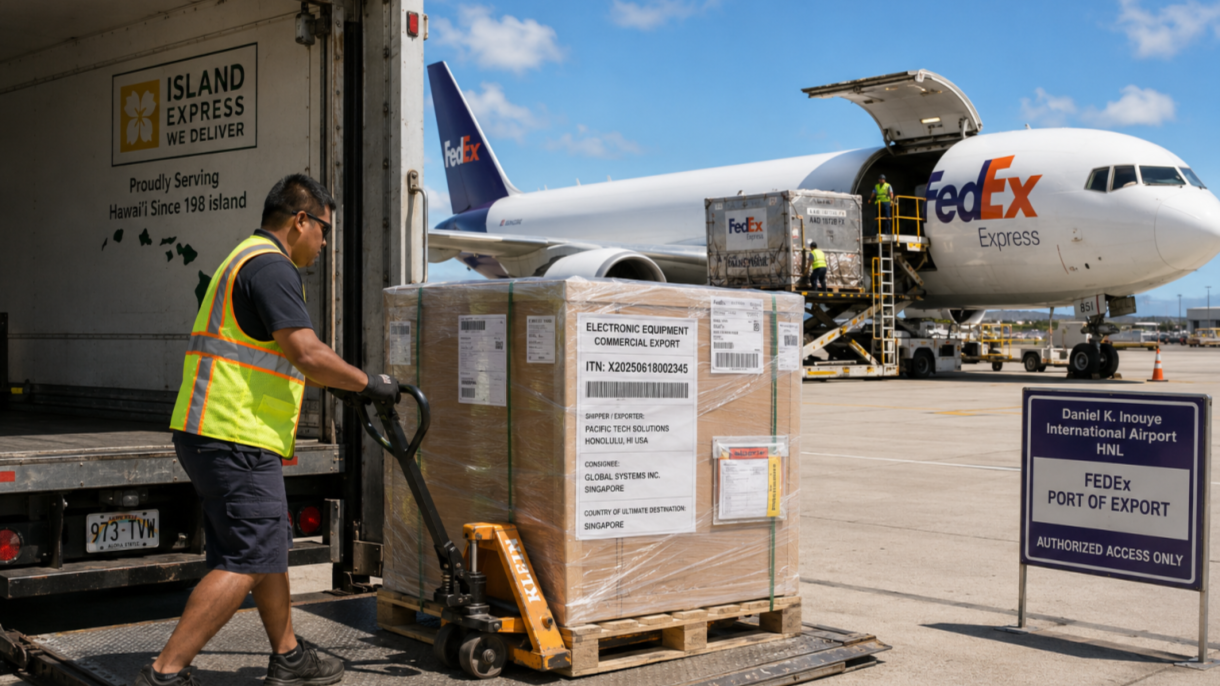
Faster Pickups: Understanding FedEx Port of Export Protocols
The FedEx port of export is the CBP-coded location where your cargo physically leaves the United States — not the address where the driver collected it. Confuse the two and a shipment with a confirmed booking can sit untouched while everyone waits on a corrected filing.
For Hawaii businesses, that distinction has teeth. Outbound cargo usually departs through Honolulu Harbor or HNL, and a mismatched port of export code can freeze a container that already has a vessel, a customer, and a promised delivery date attached to it. The cost is almost never the penalty. It is the week you lose.
This guide explains exactly what the FedEx port of export is, how to identify the right code for your shipment, and how to sequence export documentation so the pickup is the last step instead of the stalled one. Start with what the term actually describes.
What the FedEx Port of Export Really Means for Your Shipment
The FedEx port of export is the four-digit port code, drawn from CBP's Schedule D list, that identifies where your goods cross the U.S. border on their way out of the country. It is a required field in the Automated Export System (AES), and it is bound to the mode of transport — an air movement is filed against an air-eligible port, a vessel movement against a vessel-eligible one. It does not describe where FedEx picked up the freight or where the shipment was consolidated. It marks the final point of U.S. departure, nothing else.
That distinction matters because CBP treats an incorrect port of export code as a filing error, and it sits among the errors the agency penalizes most often. For an Oahu business, the fallout is rarely financial. It is time. A rejected filing means no Internal Transaction Number (ITN), and without an ITN on the air waybill, the shipment legally does not move — even though your driver has already run the pickup and your freight is already staged.
Getting the field right before dispatch gives you:
- A valid ITN in hand before the truck arrives, so pickup and departure land in the same day
- Fewer holds at the terminal, which protects free time and keeps demurrage off the invoice
- Clean handoffs between your carrier and your Port of Honolulu drayage provider
- Export documentation that matches across the commercial invoice, the air waybill, and the AES record
The most common mistake is assuming the port of export is simply the nearest port to your warehouse. If your freight routes through a mainland hub before leaving the country, the mainland port is the correct entry — not Honolulu. Mapping that routing early, alongside your ocean freight planning, keeps the paperwork honest from the first scan.
How to Confirm Your FedEx Port of Export and Book a Faster Pickup
Most delayed international pickups trace back to the same root cause: the paperwork was started after the truck was scheduled. Reverse that order and the FedEx port of export stops being a bottleneck. Here is the sequence that works.
Step 1: Confirm how the shipment is actually leaving the country. Before anything else, ask your carrier or forwarder for the routing — not the destination, the routing. A shipment tendered in Honolulu may depart on a flight out of HNL, or it may move to a mainland gateway first and leave from there. The last U.S. point of departure is the only thing that determines your code. Guessing here is what generates most rejections.
Step 2: Match the port code to the mode of transport. Each port in CBP's Schedule D list accepts specific modes. An ocean-only port code filed against an air shipment will error out immediately. Cross-check your selected code against AESTIR Appendix D, which confirms which modes each port supports, and verify the code itself against the current Schedule D list rather than reusing one from an old file.
Step 3: Determine whether you owe an EEI filing at all. Electronic Export Information is required when goods under a single Schedule B number, sent from the same exporter to the same consignee on the same day, exceed $2,500 in value — or whenever a license, permit, or ITAR control applies regardless of value. Certain Canada-bound shipments are exempt unless those controls are in play. Note that freight moving between Hawaii and the mainland is domestic, so no EEI or port of export applies.
Step 4: File AES early and secure the ITN. Non-ITAR shipments must be transmitted no later than two hours before export; ITAR shipments require eight. Those are ceilings, not targets. File the day before whenever you can. You can self-file through the ACE AESDirect portal at no cost, use the FedEx Export AgentFile tool, or authorize FedEx to file on your behalf. Whichever route you take, the goal is the same — an accepted ITN before dispatch.
Step 5: Put the ITN and port code on every document. The ITN belongs on the air waybill or electronic label so CBP can retrieve the filing. Then make sure the commercial invoice, packing list, and AES record agree on value, Schedule B classification, and consignee. Mismatched documents are the second-biggest source of customs clearance delays after a bad port code, and they are entirely preventable with a five-minute review.
Step 6: Schedule the pickup around the filing. Once the ITN is accepted, book the truck. For island shippers this is where local coordination earns its keep — a daily container drayage run timed to a confirmed filing beats a rushed pickup that lands cargo at a terminal it cannot legally leave. Coordinate the appointment window, the equipment type, and the gate cutoff in one conversation rather than three.
Step 7: Build a buffer for island realities. Oahu has a single major commercial harbor, limited terminal hours, and vessel schedules that do not flex. If your documentation clears late on a Friday, the practical cost may be a full sailing. Holding cargo in warehouse storage in Honolulu until the filing is confirmed is usually cheaper than accruing demurrage at the terminal while you chase a correction.
A note on repeat lanes: if you ship the same product to the same consignee regularly, build a one-page lane sheet that locks in the Schedule B number, the port code, the mode, and the filing owner. It turns a recurring research task into a checkbox, and it removes the single most common cause of a missed cutoff.
How Oahu Shippers Apply This in Practice
The theory is straightforward. Watching it play out on a real dock is what makes it stick — here are three situations that show the pattern.
A Kapolei manufacturer shipping equipment to Asia. The team had been booking pickups first and filing AES after, which repeatedly left cargo sitting at the terminal overnight. Once they moved the FedEx port of export confirmation to the day before dispatch, the ITN was in hand at loading, and outbound shipments started clearing the gate on the first attempt instead of the second.
A Honolulu food exporter with a perishable window. Product value crossed the $2,500 threshold under a single Schedule B number, so EEI was mandatory. By locking the port code and filing eight hours ahead rather than two, the shipper protected the cold chain and avoided a rollover to the next flight — the difference between delivered product and written-off product.
A retailer running mixed outbound volume. Some of its freight leaves the country; most simply moves to the mainland. Separating the two flows on the Hawaii-to-mainland freight shipping side meant staff stopped filing exports that were never exports, cutting wasted admin hours each week.
None of these shippers changed carriers. They changed sequence — and the FedEx port of export stopped being the thing that held up a pickup.
Pro Tips for Faster Pickups and Cleaner Export Filings
Understanding the rules and running them well are different skills. These habits separate shippers who file correctly from shippers who file correctly and on time.
Verify the code with the carrier, not the map. Your carrier knows the routing; a map only knows geography. A five-minute confirmation call before you file prevents the single most penalized error in AES. When routing changes mid-quarter — and on island lanes it does — re-confirm rather than reusing last month's FedEx port of export entry.
Treat the two-hour deadline as an emergency, not a plan. Filing at the legal minimum leaves no room for a rejection. Targeting 24 hours ahead gives you a full business day to correct a Schedule B number or a consignee mismatch, which is usually all a rejection requires. The cost of filing early is zero; the cost of filing late is a sailing.
Keep one owner for export documentation. When the commercial invoice, the packing list, and the FedEx port of export field are handled by three people, they disagree. Assign one owner per shipment and one reviewer. If you want a broader view of how local handoffs affect timing, the freight logistics FAQ covers the coordination side in plain terms.
Applied consistently, these three habits remove most of the avoidable friction between a booked pickup and a shipment that actually departs.
Turning Export Protocols Into Predictable Pickups
The FedEx port of export is a small field with outsized consequences. It identifies where your goods leave the United States, it must match your mode of transport, and it drives the AES filing that produces the ITN your shipment cannot depart without. Get the sequence right — confirm routing, verify the code, file early, then book the truck — and international pickups stop being the unpredictable part of your week.
That predictability compounds. Fewer customs clearance delays mean fewer demurrage charges, fewer missed sailings, and fewer apologies to customers who were promised a date. For Oahu businesses working around a single commercial harbor and fixed vessel schedules, controlling what you can control is the whole game.
The other half of the equation is what happens on the ground here. If your export documentation is clean but your freight is still arriving at the terminal late, the gap is local coordination, and the right freight services on Oahu partner closes it quickly. When you are ready to tighten the handoff between your filing and your cargo, talk to our drayage team at the Port of Honolulu about scheduling pickups around your FedEx port of export timeline instead of against it.
FedEx Port of Export: Frequently Asked Questions
What is the FedEx port of export on my shipping documents? It is the four-digit CBP Schedule D code identifying where your goods physically leave the United States. It is a required field in the Automated Export System and must match your mode of transport. It is not the pickup address and not the consolidation point — only the final U.S. departure location counts.
Can I use Honolulu as my port of export for every outbound shipment? Only if the goods actually leave the country from Honolulu. If your freight moves to a mainland gateway first and departs from there, the mainland port is the correct entry. Confirm the routing with your carrier before filing — an incorrect FedEx port of export code is among the errors CBP penalizes most frequently.
Do I need an EEI filing for freight going from Hawaii to the mainland? No. Hawaii is a U.S. state, so mainland movements are domestic and require no EEI, ITN, or port of export. Those shipments do still need solid container planning, and choosing between LCL and FCL shipping usually has more impact on your cost and timing than any documentation step.
How early should I file to avoid a delayed pickup? Legally, two hours before export for non-ITAR shipments and eight hours for ITAR shipments. Practically, file 24 hours ahead. That buffer gives you a business day to fix a rejection without missing a cutoff, and it lets you schedule the truck after the ITN is confirmed rather than hoping both land together.
About the Author
Ryan Malaluan, CAPM®, is an SEO & Content Strategist with over 8 years of experience in SEO, content strategy, and digital marketing. He holds a Bachelor of Arts in Literature and is a Certified Associate in Project Management (CAPM®). Throughout his career, Ryan has worked with brands including Spacer, Airtasker, Marlee (formerly Fingerprint for Success), VEED.IO, and ROSEMET LLC, as well as several digital marketing agencies, helping businesses strengthen their organic visibility through strategic, results-focused SEO and content.