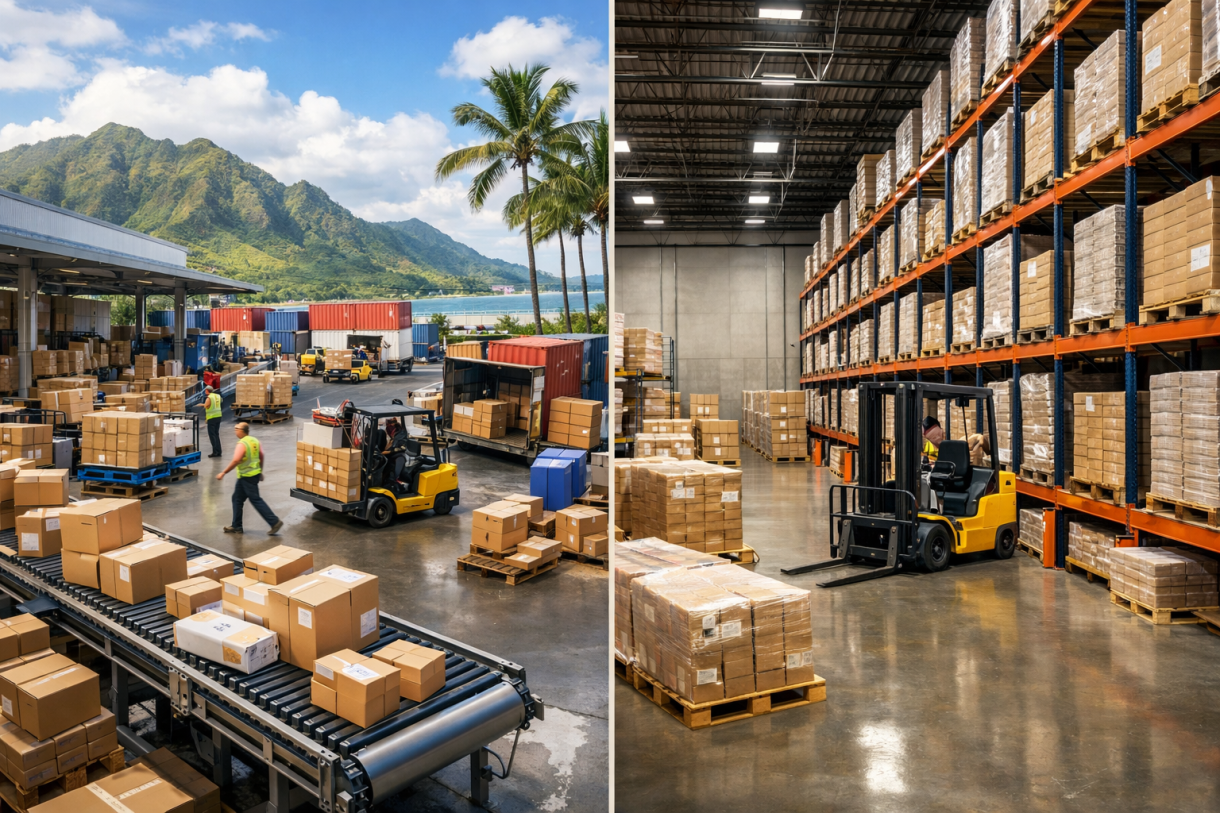
Distribution Center vs Warehouse
Understanding the Key Differences Between Distribution Centers and Warehouses
If you operate a business in Hawaii, logistics decisions carry more weight than they might on the mainland. Limited land availability, higher shipping costs, port dependency, and inter-island transportation all increase the importance of choosing the right facility.
One common question businesses ask is: distribution center vs warehouse, which one do I need?
At first glance, these facilities appear similar. Both store inventory. Both support supply chains. However, their purpose, speed, and operational structure are very different.
Choosing the wrong option can lead to:
- Slower fulfillment
- Higher carrying costs
- Delivery delays
- Inventory bottlenecks
In this guide, we will break down:
- The difference between warehouse and distribution center
- What is a distribution center
- Whether warehouses and distribution centers are the same
- When to use each facility in Hawaii
- How geography impacts your decision
Let’s start by clearly defining each facility.
What Is a Warehouse?
A warehouse is a facility primarily designed for storage. Its main function is to hold goods safely until they are needed.
Warehouse Definition
A warehouse is a building used for storing inventory, often for extended periods, with systems focused on organization and inventory tracking rather than rapid order fulfillment.
Warehouses typically support:
- Bulk inventory storage
- Seasonal goods
- Backup stock
- Long-term inventory reserves
For businesses importing goods from the mainland, warehouse storage such as long-term storage services provides stability and cost control.
Is a Warehouse Long Term Storage?
Yes, in most cases. Warehouses are commonly used for long-term storage, particularly for slow-moving inventory or bulk shipments.
Shorter holding periods are also possible through short-term storage services, but the facility’s design still prioritizes storage over speed.
What Is a Distribution Center?
To understand the distribution center definition, think of movement rather than storage.
A distribution center is a logistics hub designed for rapid processing, sorting, and shipping of goods. Inventory flows through the facility quickly instead of sitting for extended periods.
What Is a Distribution Center Used For?
Distribution centers support:
- Order fulfillment
- Retail replenishment
- eCommerce shipping
- Inter-island routing
- Break bulk processing
Services like break bulk distribution are common within distribution center environments, where large shipments are divided and routed efficiently.
Unlike warehouses, distribution centers emphasize speed, accuracy, and shipment turnover.
Distribution Center vs Warehouse: Core Differences
When comparing warehouse vs distribution center, several operational differences stand out.
1. Purpose and Operational Focus
- Warehouse: Focused on storing goods safely.
- Distribution center: Focused on moving goods quickly.
Warehouses act as inventory reserves. Distribution centers act as logistics engines.
2. Inventory Turnover
- Warehouse: Inventory may sit for weeks or months.
- Distribution center: Inventory often moves within hours or days.
High-turnover operations benefit from distribution center models.
3. Technology and Automation
Distribution centers typically rely on advanced systems such as:
- Real-time tracking
- Barcode scanning
- Order management integration
- Automated sorting
Warehouses often use simpler inventory management systems focused on storage organization.
Modern logistics operations that incorporate advanced planning strategies are further supported by insights discussed in supply chain scenario planning.
4. Staffing and Workflow
Distribution centers require:
- Flexible staffing
- Fulfillment teams
- Coordinated dispatch
- Higher operational activity
Warehouses maintain steadier workflows centered around receiving, organizing, and retrieving inventory.
5. Shipping and Delivery Role
Distribution centers directly support last-mile and inter-island delivery through services such as:
Warehouses typically support upstream logistics rather than direct fulfillment.
Are Warehouses and Distribution Centers the Same?
A common question is: are warehouses and distribution centers the same?
The short answer is no.
While both handle inventory, the difference between a warehouse and a distribution center lies in their function.
Warehouses store.
Distribution centers move.
Some facilities may combine elements of both, often referred to as a distribution warehouse definition hybrid model, but their primary purpose still determines classification.
How Hawaii’s Geography Influences the Decision
The distribution center vs warehouse decision is more strategic in Hawaii than in mainland markets.
Key geographic factors include:
- Port dependency
- Limited highway routes
- Inter-island shipping
- Higher fuel costs
- Weather disruptions
For businesses importing containers via daily container drayage, warehouses can buffer against shipping delays.
However, for companies distributing goods across islands using:
- Flatbed trucks
- Flatbed drop deck trailers
- Dry and refrigerated box trucks
- Inside pick delivery
- Forklift delivery
distribution centers provide speed and flexibility.
In many cases, Hawaii businesses benefit from using both.
When to Choose a Warehouse
A warehouse may be the right option if:
- You store bulk inventory
- Your turnover is slow
- You need buffer stock against port delays
- Cost control is a primary concern
- You manage seasonal goods
Warehouses provide stability and predictable storage expenses.
When to Choose a Distribution Center
A distribution center may be better if:
- You require fast order fulfillment
- You serve multiple islands
- You operate retail or eCommerce channels
- Customer delivery speed is critical
- Inventory turnover is high
Distribution centers reduce dwell time and improve delivery reliability.
Common Mistakes Businesses Make
Overestimating Storage Needs
Renting excess warehouse space “just in case” ties up capital unnecessarily.
Ignoring Fulfillment Expectations
If customers expect fast delivery, relying only on storage-focused facilities may hurt service performance.
Underestimating Shipping Constraints
Hawaii logistics requires realistic scheduling around port and transit timelines.
Overlooking Technology Requirements
Distribution centers demand stronger inventory systems than traditional warehouses.
Avoiding these mistakes ensures your logistics infrastructure supports growth rather than limiting it.
Can You Use Both a Warehouse and Distribution Center?
Yes. Many Hawaii businesses operate hybrid models.
A common approach is:
- Receive mainland shipments via drayage.
- Store bulk goods in a warehouse.
- Transfer inventory to a distribution center for rapid fulfillment.
This model balances cost efficiency with delivery speed.
Final Thoughts on Distribution Center vs Warehouse
The distribution center vs warehouse decision ultimately comes down to storage versus speed.
Warehouses provide:
- Long-term inventory stability
- Lower operating complexity
- Cost-effective bulk storage
Distribution centers provide:
- Faster fulfillment
- Improved customer service
- Higher inventory turnover
- Greater operational flexibility
In Hawaii’s unique logistics environment, understanding the difference between warehouse and distribution center allows businesses to design smarter supply chains.
When aligned with your growth strategy, the right facility becomes a competitive advantage.
Frequently Asked Questions
1. What is the main difference between a distribution center and a warehouse?
The main difference between a warehouse and a distribution center is function. Warehouses focus on storage, while distribution centers prioritize processing and rapid shipment.
2. Is a distribution center long term storage?
No. Distribution centers are designed for short-term holding and quick turnover, not extended storage.
3. Are warehouses and distribution centers the same?
No. While related, they serve different purposes within the supply chain.
4. Which option supports faster delivery in Hawaii?
In most cases, a distribution center supports faster customer delivery, especially for inter-island shipments.
5. Can small businesses benefit from a distribution center?
Yes. Even small operations benefit when customer speed expectations are high or inventory turnover is frequent.
Choosing between a warehouse and distribution center is not just a logistical detail. It is a strategic decision that directly impacts efficiency, cost, and customer satisfaction.